
Introduction
The Indian Contract Act, 1872 provides the legal framework governing contracts in India. A contract is not merely an agreement between two or more persons; it is an agreement that is enforceable by law.
Section 2(h) of the Indian Contract Act, 1872 defines a contract as “an agreement enforceable by law.” Therefore, although every contract is an agreement, every agreement does not necessarily become a contract.
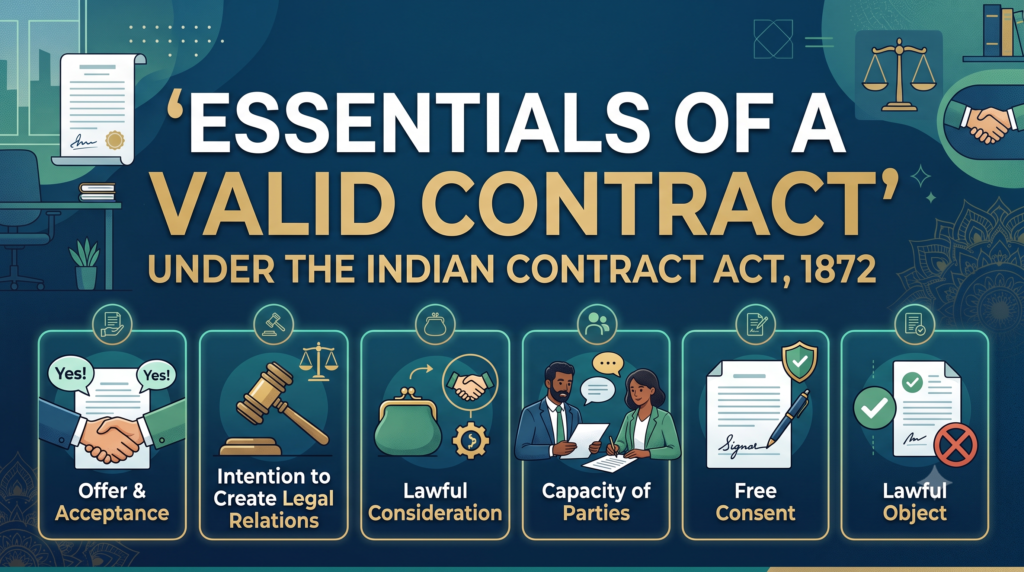
Section 10 lays down the principal requirements for an agreement to become a valid contract. According to Section 10, an agreement becomes a contract when it is made:
- By the free consent of the parties;
- Between parties competent to contract;
- For a lawful consideration;
- With a lawful object; and
- It is not expressly declared to be void.
In addition to these statutory requirements, other provisions of the Act and judicial decisions establish further requirements, such as a valid offer and acceptance, intention to create legal relations, certainty of terms, possibility of performance, and compliance with necessary legal formalities.
Meaning of Contract
The basic relationship between offer, acceptance, agreement and contract can be understood as follows:
Offer + Acceptance = Promise
Promise + Consideration = Agreement
Agreement + Enforceability by Law = Contract
Thus:
Contract = Agreement + Enforceability by Law
This formula explains why an agreement does not automatically become a contract. The agreement must satisfy the legal requirements prescribed by the Contract Act and other applicable laws.
Essentials of a Valid Contract
1. Proper Offer and Proper Acceptance
A valid contract generally begins with an offer or proposal made by one party and its valid acceptance by another party.
Under Section 2(a), a proposal is made when one person signifies to another his willingness to do or abstain from doing something with a view to obtaining the assent of that other person.
Acceptance of the proposal converts it into a promise under Section 2(b).
Therefore, there must be a clear offer and a corresponding acceptance. The acceptance must generally correspond with the terms of the offer and must be communicated in the manner required by law.
Example
A offers to sell his laptop to B for ₹30,000. B agrees to purchase the laptop for ₹30,000. If the other legal requirements are satisfied, the offer and acceptance may form the basis of a contract.
2. Intention to Create Legal Relations
The parties must intend that their agreement should create legal obligations.
This requirement is particularly important when distinguishing commercial agreements from social or domestic arrangements.
For example, if A and B agree to watch a movie together on Sunday and A does not appear, B ordinarily cannot claim damages for breach of contract. Such an arrangement is generally social in nature and lacks an intention to create legal relations.
The principle is illustrated by the famous English case of Balfour v. Balfour, where the court recognized that ordinary domestic arrangements between spouses are generally not intended to create legally enforceable obligations.
In contrast, in commercial transactions, there is generally a presumption that the parties intend to create legal relations.
Therefore:
Social/Domestic Arrangement → Generally no intention to create legal relations
Commercial Agreement → Generally presumed to involve legal intention
The presumption, however, may be rebutted depending on the circumstances.
3. Competency or Capacity of Parties
The parties entering into a contract must have the legal capacity to contract.
Section 11 of the Indian Contract Act, 1872 provides that a person is competent to contract if he:
- Has attained the age of majority according to the law applicable to him;
- Is of sound mind; and
- Is not disqualified from contracting by any law to which he is subject.
Thus, capacity is an essential requirement of a valid contract.
Agreement with a Minor
A minor is generally not competent to contract.
Under the Indian Majority Act, 1875, the general age of majority is 18 years. Accordingly, a person who has not attained the age of majority is generally not competent to enter into a binding contract.
The leading Indian case on this issue is Mohori Bibee v. Dharmodas Ghose.
In that case, a minor had executed a mortgage in respect of property for securing a loan. The Privy Council held that a minor’s agreement is void ab initio, meaning void from the beginning.
The case established an important principle:
A minor is not competent to contract, and an agreement entered into by a minor is generally void.
However, the law recognizes certain transactions involving minors, particularly where the transaction is for the minor’s benefit or is otherwise permitted by law.
4. Sound Mind
Capacity also requires that the person be of sound mind at the time of making the contract.
Section 12 explains the concept of soundness of mind for contractual purposes.
A person is of sound mind for the purpose of making a contract if, at the time of making it, he:
- is capable of understanding the contract; and
- is capable of forming a rational judgment as to its effect upon his interests.
A person who is ordinarily of unsound mind may enter into a valid contract during a period when he is of sound mind, commonly referred to as a lucid interval.
Similarly, a person who is ordinarily of sound mind cannot enter into a valid contract during a period when he is incapable of understanding the transaction and forming a rational judgment regarding it.
5. Free Consent
Consent is one of the most important requirements of a valid contract.
Section 13 provides that two or more persons are said to consent when they agree upon the same thing in the same sense. This principle is commonly expressed by the Latin phrase:
Consensus ad idem
It means “meeting of minds.”
However, mere consent is not sufficient. The consent must also be free.
According to Section 14, consent is free when it is not caused by:
- Coercion;
- Undue influence;
- Fraud;
- Misrepresentation; or
- Mistake, subject to the provisions of the Act.
Example
A threatens B with unlawful harm and forces B to enter into an agreement for the sale of property. B’s consent is not free because it has been obtained through coercion.
The effect of absence of free consent depends upon the particular vitiating factor and the applicable provisions of the Contract Act. Therefore, it is important not simply to say that every agreement involving defective consent is automatically void; some such contracts are voidable at the option of the affected party, while certain mistakes may make an agreement void.
6. Lawful Consideration
Consideration is an essential element of a contract, subject to statutory exceptions.
Section 2(d) defines consideration. In simple terms, consideration is something of value given, done, or promised in return for a promise.
Section 23 deals with the lawfulness of consideration and object.
Consideration or object is unlawful when:
- it is forbidden by law;
- it would defeat the provisions of any law;
- it is fraudulent;
- it involves or implies injury to the person or property of another;
- the court regards it as immoral; or
- it is opposed to public policy.
An agreement whose consideration or object is unlawful is not enforceable as a valid contract.
Example
A promises to pay B ₹50,000 to commit a criminal offence. The object of the agreement is unlawful. Therefore, the agreement cannot be enforced by law.
7. Lawful Object
The object or purpose of the agreement must also be lawful.
The parties cannot make a legally enforceable contract for the purpose of performing an illegal act.
Section 23 provides the principal rules governing the legality of the object and consideration.
Example
A agrees to pay B money in exchange for B committing an offence. Since the purpose of the agreement is unlawful, the agreement cannot be enforced.
It is important to distinguish between consideration and object. Consideration refers broadly to what is given in return for the promise, while the object refers to the purpose or design of the agreement.
8. Possibility of Performance
The terms of an agreement must be capable of being performed.
Section 56 deals with agreements to do acts impossible in themselves. An agreement to perform an act that is impossible from the beginning is void.
Example
A promises B that he will discover hidden treasure through magic. Since the promised act is impossible in itself, the agreement is void.
The doctrine of impossibility also becomes relevant where performance subsequently becomes impossible or unlawful, subject to the rules contained in Section 56.
9. Certainty of Terms
The terms of a contract must be certain or capable of being made certain.
Section 29 provides that agreements whose meaning is not certain, or cannot be made certain, are void.
The parties must therefore be sufficiently clear about essential terms such as the subject matter, price, quantity, or nature of performance, depending on the circumstances.
Example
A agrees to pay B ₹5 lakh for “ultra-modern decoration” of his drawing room without providing any objective basis for determining what the expression means. If the essential term is so uncertain that it cannot be made certain, the agreement may be void under Section 29.
Thus:
Uncertain Agreement → Void
provided the uncertainty cannot be resolved.
10. Agreement Must Not Be Expressly Declared Void
The Indian Contract Act expressly declares certain agreements to be void.
Therefore, even when the parties have apparently consented to an arrangement, the agreement cannot become an enforceable contract if the Act expressly declares it void.
Examples include certain agreements relating to:
- restraint of marriage;
- restraint of trade, subject to statutory exceptions;
- restraint of legal proceedings, subject to statutory exceptions;
- uncertain agreements;
- wagering agreements, subject to applicable law.
Thus, the parties cannot create a valid contract merely by mutual consent when the law expressly prohibits or declares the agreement void.
11. Compliance with Necessary Legal Formalities
A contract may generally be made orally or in writing unless a particular law requires a specific form.
Certain transactions, however, must comply with statutory requirements relating to:
- writing;
- registration;
- attestation;
- stamping; or
- other prescribed formalities.
Where the law requires such formalities, failure to comply with them may affect the validity or enforceability of the transaction.
Example
A promise to pay a time-barred debt must satisfy the requirements of Section 25(3), including being made in writing and signed by the person to be charged.
Therefore, parties must examine not only the Indian Contract Act but also other applicable statutes governing the particular transaction.
Contract and Agreement
One of the most important concepts in the law of contract is the distinction between an agreement and a contract.
Section 2(e) defines an agreement as:
“Every promise and every set of promises, forming the consideration for each other, is an agreement.”
Section 2(h), on the other hand, defines a contract as:
“An agreement enforceable by law.”
Therefore:
All contracts are agreements, but all agreements are not contracts.
An agreement becomes a contract only when it satisfies the requirements necessary for legal enforceability.
Difference Between Contract and Agreement
| Basis | Contract | Agreement |
|---|---|---|
| Definition | Section 2(h): An agreement enforceable by law | Section 2(e): Every promise and every set of promises forming consideration for each other |
| Enforceability | Enforceable by law | May or may not be enforceable by law |
| Relationship | Every contract is an agreement | Every agreement is not a contract |
| Scope | Narrower | Wider |
| Legal obligation | Creates enforceable legal obligations | May or may not create enforceable legal obligations |
| Validity | Must satisfy legal requirements | May include agreements that are void or otherwise unenforceable |
Agreement: Wider Concept Than Contract
The term agreement has a wider meaning than the term contract.
Agreements can broadly be understood as:
1. Agreements Not Enforceable by Law
If an agreement lacks one or more requirements necessary for enforceability, it may not become a contract.
Examples may include certain social arrangements or agreements that are expressly declared void.
2. Agreements Enforceable by Law
When an agreement satisfies the requirements prescribed by law and is legally enforceable, it becomes a contract.
Therefore, the relationship can be represented as:
Agreement → Enforceability by Law → Contract
Simple Formula for Understanding the Concept
The entire concept can be remembered through the following sequence:
Offer → Acceptance → Promise
Promise + Consideration → Agreement
Agreement + Enforceability by Law → Contract
Therefore:
Contract = Agreement + Enforceability by Law
This is why the statement “All contracts are agreements, but all agreements are not contracts” is a fundamental principle of contract law.
Conclusion
The Indian Contract Act, 1872 establishes the basic legal framework for determining whether an agreement can become an enforceable contract. Section 10 identifies several fundamental requirements, including free consent, competency of parties, lawful consideration, lawful object, and absence of an express declaration of voidness.
Other provisions of the Act and judicial decisions further emphasize requirements such as a valid offer and acceptance, intention to create legal relations, soundness of mind, possibility of performance, certainty of terms, and compliance with statutory formalities.
The central distinction can therefore be summarized as follows:
Every contract is an agreement, but every agreement is not a contract.
An agreement becomes a contract only when it is enforceable by law and satisfies the legal requirements governing contractual obligations.
For a student of law, understanding this distinction is fundamental because it forms the foundation for studying subsequent topics such as capacity, free consent, consideration, legality of object, void agreements, performance, breach of contract, and remedies for breach.