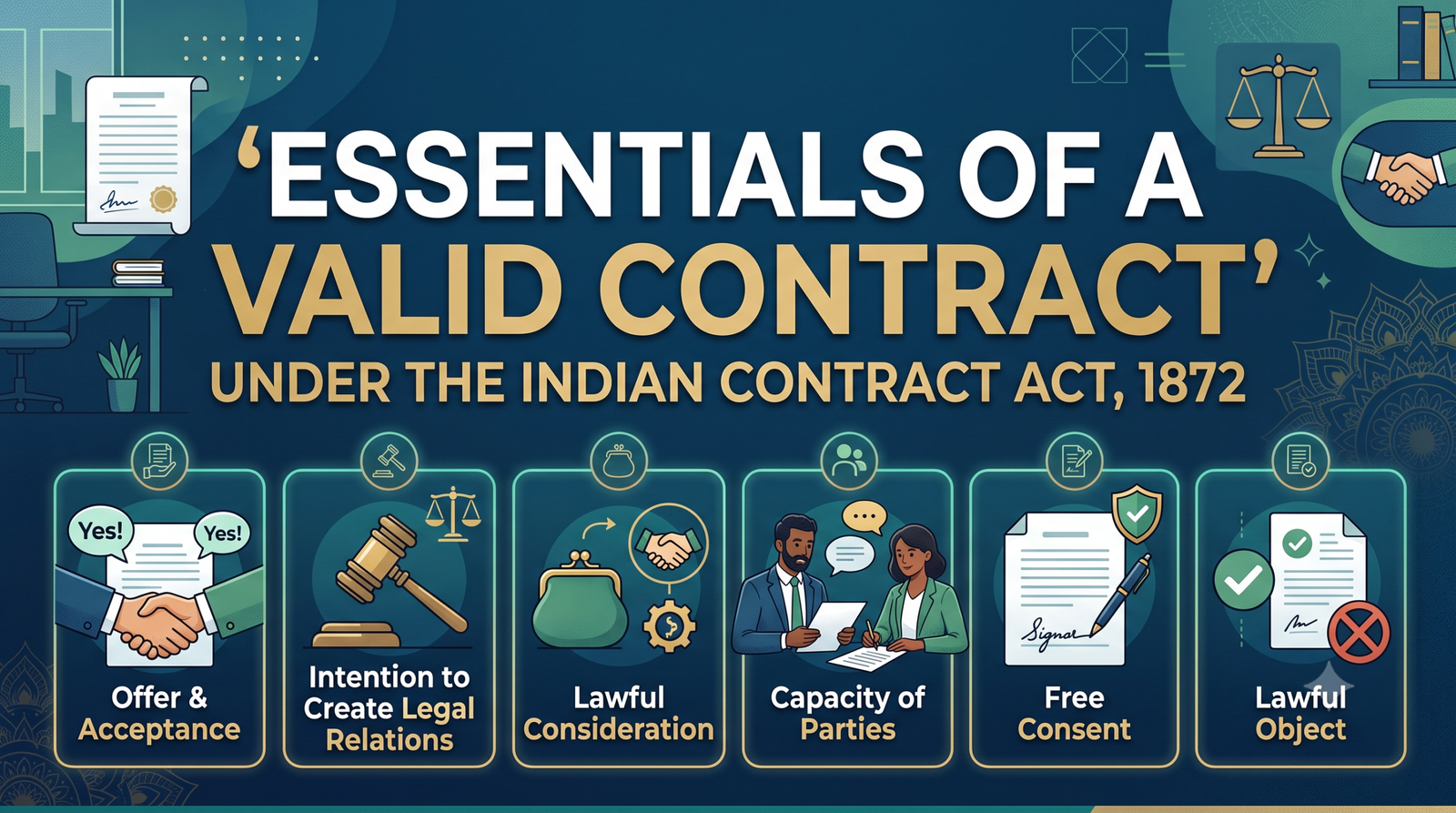
The Indian Contract Act, 1872 is the bedrock of mercantile law in India. Whether buying vegetables from a vendor, boarding a bus, or signing a multi-million dollar corporate deal, we enter into contracts daily. This Act determines the circumstances under which promises made by the parties to a contract shall be legally binding.
This article explores the historical roots, the necessity, and the scope of this pivotal legislation.
1. Historical Background
The law of contracts in India is not a modern invention but a codified version of principles that have evolved over centuries.
- Pre-1872: Before the enactment of this Act, the courts in India applied English Common Law rules suited to Indian conditions (often referred to as principles of “justice, equity, and good conscience”). However, this led to ambiguity and inconsistency in legal decisions.
- The Draft: The original draft of the Indian Contract Act was prepared by the Third Law Commission in England.
- Enactment: The Act was enacted on 25th April 1872 and came into force on 1st September 1872.
- English Roots: It is largely based on the English Common Law, but with significant modifications to suit the social and economic conditions of India.
Note: Originally, the Act also contained provisions regarding the Sale of Goods and Partnership. These were later repealed and enacted as separate legislations: The Sale of Goods Act, 1930 and The Indian Partnership Act, 1932.
2. Need and Object of the Act
Why do we need a specific law for contracts? Why can’t people just keep their word?
The Need
In a civilized society, business and trade cannot flourish without certainty. If a supplier promises to deliver raw materials and later refuses, the manufacturer suffers a loss. Without a legal framework to enforce that promise, trade would collapse. The Act was needed to create commercial certainty.
The Object
The Preamble of the Act states its objective is “to define and amend certain parts of the law relating to contracts.”
- Enforceability: The primary object is to ensure that rights and obligations arising out of an agreement are honored. It provides a legal remedy to the aggrieved party if the other party fails to perform their promise.
- Definiteness: It lays down definite rules to determine when a promise becomes a binding legal duty.
- Freedom of Contract: It allows individuals to create their own laws (terms and conditions) within the boundaries of the Act.
The underlying maxim is “Pacta Sunt Servanda”, which means agreements must be kept.
3. Scope and Applicability
The Indian Contract Act is extensive, but it is important to understand its boundaries.
Applicability
- Territorial Extent: The Act extends to the whole of India. (Previously, Jammu & Kashmir had separate status, but following the Jammu and Kashmir Reorganisation Act, 2019, central laws, including this Act, apply there as well).
- Not Retrospective: The Act is not retrospective in nature, meaning it does not apply to contracts entered into before September 1, 1872.
Scope of the Act
The Act is divided into two main parts:
| Part | Sections | Subject Matter |
| Part I | Sections 1–75 | General Principles of Contract: Covers rules relating to offer, acceptance, consideration, capacity, free consent, and breach of contract. |
| Part II | Sections 124–238 | Special Contracts: Covers Indemnity, Guarantee, Bailment, Pledge, and Agency. |
Is the Act Exhaustive?
No, the Act is not exhaustive. It does not deal with all branches of the law of contract.
- It deals with the general principles of the law of contract.
- It deals with some special contracts.
- It does not cover contracts relating to the Transfer of Property, Negotiable Instruments, Sale of Goods, or Partnership, which are governed by their specific Acts.
Furthermore, Section 1 of the Act preserves any usage or custom of trade not inconsistent with the Act. If a specific trade custom prevails that does not contradict the Act, that custom remains valid.
Conclusion
The Indian Contract Act, 1872, is not just a statute; it is the framework that facilitates economic activity in India. By distinguishing between a casual social agreement (like agreeing to meet for lunch) and a legally binding contract (like buying a house), it brings order and predictability to human interactions.
Understanding the historical context and scope of this Act is the first step in mastering Mercantile Law.
Important articles
-
 September 17, 2026
Acceptance under the Indian Contract Act, 1872 – Meaning, Rules, Communication & Case Laws
Spread the love Introduction Acceptance is the second essential stage in the formation of a contract. An offer by itself does not create a contract. TheRead more -
September 17, 2026
Offer (Proposal) under the Indian Contract Act, 1872
Spread the love Introduction An offer, called a proposal under the Indian Contract Act, 1872, is the starting point of a contractual relationship. Before a contractRead more -
September 17, 2026
Essentials of a Valid Contract under the Indian Contract Act, 1872
Spread the love Introduction The Indian Contract Act, 1872 provides the legal framework governing contracts in India. A contract is not merely an agreement between twoRead more