
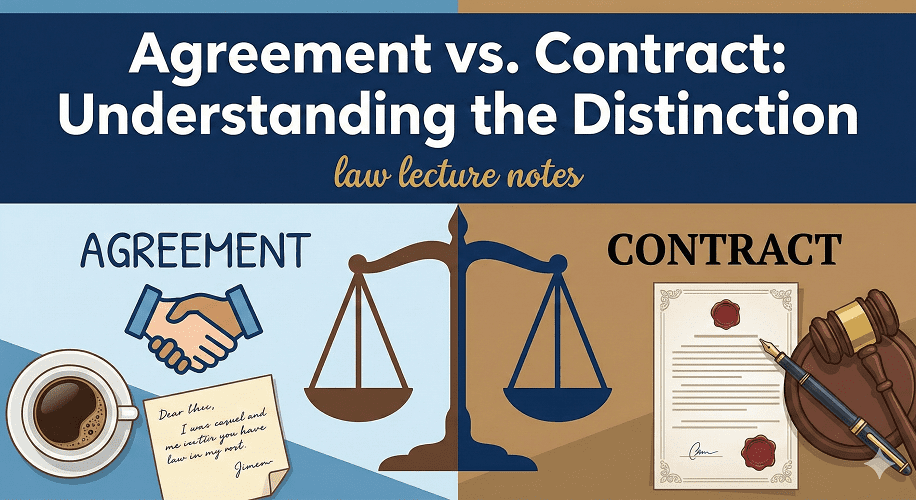
While the terms “agreement” and “contract” are often used interchangeably in daily conversation, in the eyes of the law, they have distinct meanings.1 As the legal maxim goes: “All contracts are agreements, but all agreements are not contracts.”
1. Definition of Agreement (Section 2(e))
The Indian Contract Act defines an agreement in Section 2(e) as:
“Every promise and every set of promises, forming the consideration for each other, is an agreement.”
To understand this definition, we must understand what a “promise” is.
- Promise (Section 2(b)): When a person makes a proposal (offer) to another, and that proposal is accepted, it becomes a promise.
Therefore, the formula for an agreement is:
$$\text{Offer} + \text{Acceptance} = \text{Agreement}$$
Key Characteristic: An agreement creates a mutual obligation, but this obligation may be social, moral, or legal.
2. Difference Between Agreement and Contract
The primary difference lies in enforceability. A contract is a specific type of agreement that the law will uphold.2
| Basis of Difference | Agreement | Contract |
| Definition | “Every promise and every set of promises, forming the consideration for each other.” (Sec 2(e)) | “An agreement enforceable by law.” (Sec 2(h)) |
| Formula | Offer + Acceptance | Agreement + Enforceability |
| Scope | Wider Scope: It includes both legal and social/domestic agreements. | Narrow Scope: It is a subset of agreements. Only legally enforceable agreements are contracts. |
| Legal Obligation | It may or may not create a legal duty. (e.g., a promise to go to a movie is an agreement but creates no legal duty). | It always creates a legal duty and is binding on the parties. |
| Breach | No legal remedy is available for the breach of a social agreement. | The aggrieved party can sue for damages or specific performance in court. |
3. Which Agreements are Contracts?
Not every handshake or verbal promise turns into a contract. For an agreement to mature into a contract, it must pass the “test of enforceability.”
Section 10 of the Act clarifies which agreements are contracts:
“All agreements are contracts if they are made by the free consent of parties competent to contract, for a lawful consideration and with a lawful object, and are not hereby expressly declared to be void.”
Therefore, an agreement becomes a contract ONLY if it fulfills these conditions:
- Intention to create legal relations: The parties must intend for the agreement to have legal consequences.3
- Free Consent: The agreement must not be forced (no coercion, fraud, etc.).
- Competency: Parties must be adults (majors) and of sound mind.
- Lawful Consideration: Something of value must be exchanged, and it must not be illegal.4
- Not Void: The agreement must not be of a type specifically forbidden by law (e.g., an agreement to commit a crime or a wagering agreement).
Summary
- Social Agreement: “I will come to your party.” Not a Contract (No legal intent).
- Void Agreement: “I will pay you to beat up X.” Not a Contract (Unlawful object).
- Valid Contract: “I will sell you my bike for ₹5,000.” Contract (Meets all legal requirements)