
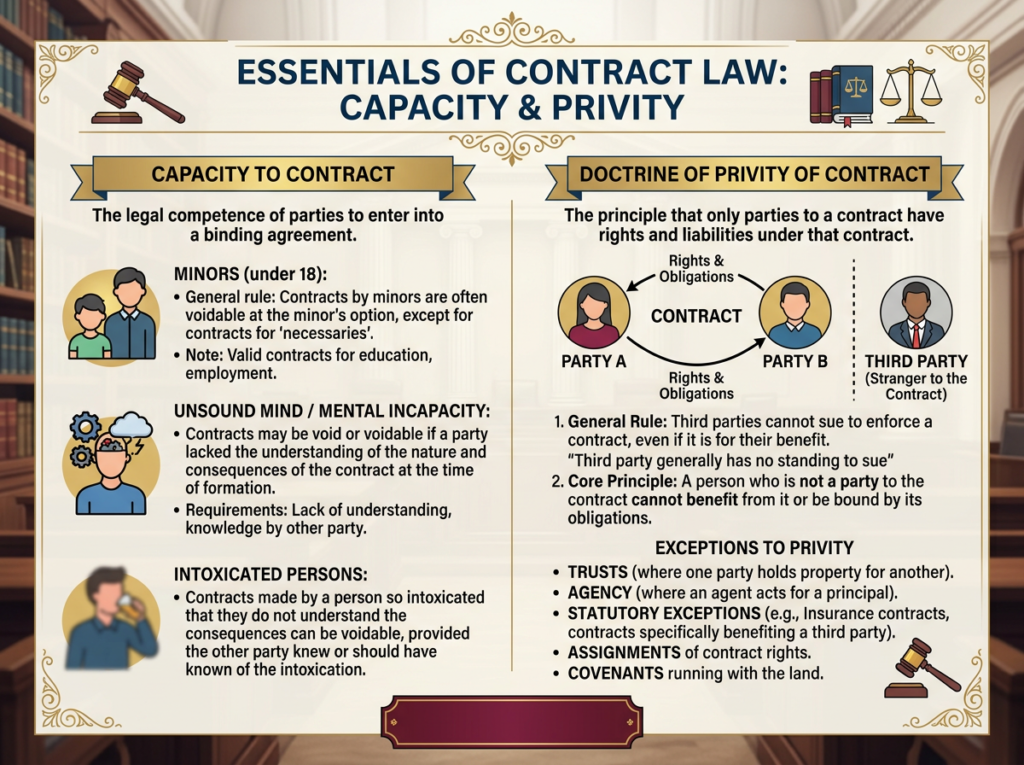
Introduction
For a contract to be legally enforceable, the parties entering into it must have the legal capacity to contract. Mere consent between two persons is not sufficient. The law requires the parties to possess the necessary legal competence to understand and undertake contractual obligations.
Section 11 of the Indian Contract Act, 1872 lays down the basic rule of competency to contract. According to it, every person is competent to contract who:
- has attained the age of majority according to the law to which he is subject;
- is of sound mind; and
- is not disqualified from contracting by any law to which he is subject.
Section 12 explains what is meant by sound mind for the purpose of making a contract.
Thus, contractual capacity can be understood through three questions:
Has the person attained majority?
Is the person of sound mind at the time of contracting?
Is the person otherwise disqualified by law?
The topic also leads to another important principle of contract law: the Doctrine of Privity of Contract, under which a person who is not a party to a contract generally cannot enforce that contract, subject to recognized exceptions.
1. Who Is Competent to Contract?
Section 11 of the Indian Contract Act, 1872 provides:
“Every person is competent to contract who is of the age of majority according to the law to which he is subject, and who is of sound mind and is not disqualified from contracting by any law to which he is subject.”
Accordingly, competency depends upon three essential requirements:
Majority + Sound Mind + No Legal Disqualification
A failure to satisfy any of these requirements may affect the enforceability of the agreement.
2. Age of Majority
The first requirement under Section 11 is that a person must have attained the age of majority.
Under Section 3 of the Indian Majority Act, 1875, the general rule is that a person domiciled in India attains majority on completing 18 years of age.
The older distinction under which majority could extend to 21 years in certain guardianship situations has been removed by the present statutory position. Therefore, for current study purposes, the general age of majority is 18 years.
3. Minor and Contractual Capacity
A person who has not attained majority is a minor and is generally not competent to enter into an ordinary binding contract.
The leading case is:
Mohori Bibee v. Dharmodas Ghose
In this case, a minor had executed a mortgage in favour of a money-lender. The Privy Council held that the agreement entered into by the minor was void ab initio, that is, void from the beginning.
Principle
A minor’s agreement is generally void ab initio.
This is one of the most important rules relating to capacity to contract.
4. Characteristics of a Minor’s Agreement
A. Minor’s Agreement Is Void Ab Initio
A minor’s ordinary contractual agreement does not merely become void later; it is generally void from the beginning.
Therefore, a minor cannot ordinarily be made personally liable on such an agreement.
Example
A, aged 16, borrows ₹50,000 from B and executes a loan agreement.
The ordinary contractual obligation cannot be enforced against A merely on the basis of that agreement because A is a minor.
B. Minor Cannot Ratify a Void Agreement Merely on Attaining Majority
Since a minor’s agreement is void from the beginning, it cannot ordinarily be ratified merely by attaining majority.
After attaining majority, the person must enter into a fresh and legally valid agreement if a new contractual obligation is intended.
C. Minor Can Be a Beneficiary
Although a minor is generally not competent to undertake contractual obligations, a minor can receive a benefit under a transaction.
For example, property or other benefits may be transferred to a minor where the transaction is otherwise legally valid.
Thus:
A minor may be a beneficiary even though he cannot ordinarily be personally bound by a contract.
5. Minor and Partnership
A minor cannot become a full partner in a partnership firm because partnership involves contractual obligations.
However, under Section 30 of the Indian Partnership Act, 1932, a minor may be admitted to the benefits of an existing partnership, with the consent of all the partners.
This means that the minor may receive the benefits of partnership but does not become personally liable in the same manner as an adult partner.
6. Minor’s Liability for Necessaries
Although a minor is not personally liable under an ordinary contract, the law makes special provision for necessaries supplied to a person incapable of contracting.
Section 68 of the Indian Contract Act provides that where necessaries suited to the condition in life of a person incapable of contracting are supplied to him, or to persons whom he is legally bound to support, the supplier is entitled to reimbursement from the property of that person.
The important point is:
The minor is not personally liable; the minor’s property may be liable for the reasonable value of necessaries.
Examples of Necessaries
Depending on the circumstances, courts may regard the following as necessaries:
- Food;
- Clothing;
- Shelter;
- Medicine;
- Education;
- Basic training or instruction;
- Expenses necessary for protection of property.
Whether something is a “necessary” depends upon the minor’s condition in life and actual requirements. A luxury or unnecessary item will not become a necessary simply because it was supplied to the minor.
7. Minor’s Fraudulent Representation
A minor may sometimes falsely represent himself as a major.
However, such fraudulent representation does not generally transform a void agreement into a valid contract.
The principle flowing from Mohori Bibee v. Dharmodas Ghose remains important:
A minor cannot be made personally liable merely because he falsely represented his age.
At the same time, issues of restitution, property and equitable relief must be considered separately according to the facts and applicable law.
8. Contracts Made by a Guardian on Behalf of a Minor
A guardian may, in appropriate circumstances, enter into a transaction on behalf of a minor.
However, the guardian’s authority is not unlimited.
A transaction entered into by a guardian must generally:
- fall within the guardian’s legal authority;
- be for the benefit or necessity of the minor where required; and
- comply with applicable statutory requirements.
Where a law requires prior permission of a court for a particular transaction involving a minor’s property, that requirement must be followed.
Therefore, it is incorrect to assume that every contract entered into by a parent or guardian on behalf of a minor automatically binds the minor.
9. Minor as an Agent
A minor may act as an agent.
Section 184 of the Indian Contract Act provides that as between the principal and third persons, any person may become an agent, but a person who is not of the age of majority and sound mind cannot become responsible to the principal in the manner required of a competent contracting person.
Thus, a minor may act as an agent but does not incur contractual liability merely by assuming that role.
10. Minor and Company Shares
The position of a minor in relation to company shares is governed primarily by company law, not simply by the Contract Act.
A minor may, in appropriate circumstances, hold shares through a guardian, particularly where the shares are fully paid and the arrangement complies with applicable company-law requirements.
Therefore, the statement that a minor can never become a shareholder is too broad.
11. Minor and Insolvency
A minor is generally not personally liable for contractual debts because he is not competent to enter into ordinary contracts.
Consequently, the law of insolvency applicable to an adult debtor does not operate against a minor in the same contractual manner.
Questions concerning the minor’s property and liabilities for necessaries must be considered separately.
12. Minor and Beneficial Contracts
Although a minor cannot generally be personally bound by an ordinary contract, transactions entered into for the benefit of the minor may be recognized by law.
Examples may include transactions relating to:
- Education;
- Training;
- Apprenticeship;
- Beneficial property arrangements; and
- Other transactions legally permitted for the minor’s benefit.
The legality of each transaction depends upon its terms and the applicable statute.
13. Minor’s Liability for Torts
A minor can generally be liable for an independent civil wrong (tort).
However, the law does not permit a person to do indirectly through a tort what the law prevents him from doing directly through a contract.
Example
A 15-year-old negligently injures B while driving a vehicle.
The consequences may arise under the law of torts independently of any contractual agreement.
Thus:
Contractual incapacity does not mean complete immunity from civil liability.
14. Person of Unsound Mind
Section 12 of the Indian Contract Act, 1872 deals with the concept of soundness of mind.
A person is of sound mind for the purpose of making a contract if, at the time of making it, he:
- is capable of understanding the contract; and
- is capable of forming a rational judgment about its effect on his interests.
The important point is that capacity is judged at the time the contract is made.
15. Persons Generally of Unsound Mind but Occasionally of Sound Mind
A person may ordinarily suffer from mental incapacity but may occasionally be capable of understanding contractual matters.
Such a person may enter into a contract during a period when he is of sound mind.
Example
A person who ordinarily has periods of mental incapacity may enter into a contract during a period in which he is fully capable of understanding the transaction and forming a rational judgment.
This is sometimes referred to as a lucid interval.
16. Persons Generally of Sound Mind but Temporarily of Unsound Mind
Conversely, a person who is ordinarily of sound mind may temporarily become incapable of understanding the contract.
Examples may include a person who is:
- delirious due to illness;
- severely intoxicated; or
- temporarily suffering from another condition that prevents rational understanding.
If the person cannot understand the transaction at that particular time, he cannot validly enter into the contract during that period.
17. Historical Terms Relating to Mental Capacity
Traditional textbooks sometimes use terms such as “idiot” or “lunatic.”
These are historical legal terms and are now regarded as outdated and inappropriate in ordinary discussion.
For modern legal study, it is preferable to use expressions such as:
- person of unsound mind;
- person lacking contractual capacity; and
- temporary mental incapacity.
The legal test under Section 12 is functional: whether the person could understand the contract and form a rational judgment regarding its effect on his interests at the relevant time.
18. Intoxicated Persons
A person who is intoxicated is not automatically incapable of contracting.
The relevant question is whether, at the time of making the contract, the person’s condition was such that he could not understand the contract or form a rational judgment about its effect on his interests.
Therefore:
Intoxication may affect contractual capacity when it actually prevents understanding and rational judgment.
19. Persons Disqualified by Law
The third requirement under Section 11 is that the person must not be disqualified from contracting by any applicable law.
Certain legal disabilities may arise from the person’s status or circumstances.
Examples traditionally discussed in contract-law textbooks include:
- Alien enemies;
- Foreign sovereigns and certain diplomatic representatives;
- Persons under particular legal restrictions;
- Insolvents in relation to property vested in the insolvency estate; and
- Corporations or companies acting beyond their legal powers.
The extent of incapacity depends upon the specific statute governing the person or transaction.
20. Alien Enemy
An alien means a foreign national.
An alien may generally be an alien friend when the person’s country is at peace with India. In wartime, a national of an enemy state may be treated as an alien enemy.
Contracts involving an alien enemy during war can be subject to restrictions imposed by law and government policy.
Therefore, an alien enemy cannot simply be treated as having the same contractual freedom as an ordinary citizen during wartime.
21. Foreign Sovereign and Diplomatic Representatives
Foreign sovereigns and diplomats may enter into transactions, but their ability to be sued in Indian courts is governed principally by the Code of Civil Procedure, 1908, particularly the rules relating to suits against foreign States, rather than by a blanket contractual incapacity under Section 11.
The relevant statutory permissions and immunities must therefore be considered separately.
22. Convicts
The contractual capacity of a person undergoing imprisonment should not be described as a universal prohibition on entering every kind of contract.
The legal consequences depend on the particular transaction and the applicable law.
Therefore, the traditional textbook statement that a convict “cannot enter into a contract” is too broad. The person’s legal rights may be restricted in particular circumstances, but imprisonment does not automatically make every contractual transaction void.
23. Insolvent Persons
Insolvency may affect a person’s ability to deal with property that has vested in an official assignee, trustee or other insolvency authority, depending upon the applicable insolvency law.
Thus, an insolvent person is not simply incapable of entering into every contract. The important issue is whether the particular transaction involves property or rights over which the law has placed restrictions.
24. Company or Corporation
A company is a juristic person and can enter into contracts through its authorized representatives.
Its powers are governed by the Companies Act, 2013, its constitutional documents, and other applicable laws.
Traditionally, the objects clause of the memorandum was important in determining the company’s powers.
An act that is beyond the legal capacity of the company may be described as ultra vires and may have no binding effect on the company, subject to the present statutory framework.
25. Doctrine of Privity of Contract
After understanding contractual capacity, another important principle is the Doctrine of Privity of Contract.
Privity means that a contract creates rights and obligations primarily between the parties to the contract.
The general rule is:
A person who is not a party to a contract cannot ordinarily sue to enforce that contract.
This is called the Doctrine of Privity of Contract.
Example
A owes B ₹1,00,000.
A sells property to C, and C promises A that C will pay ₹1,00,000 directly to B.
If B was not a party to the relevant contract, the general rule is that B cannot sue merely as a stranger to the contract, subject to recognized exceptions.
26. Stranger to Contract and Stranger to Consideration
These two concepts must be carefully distinguished.
Stranger to Contract
A person who is not a party to the contract is a stranger to the contract.
The general rule is that such a person cannot sue upon it.
Stranger to Consideration
Under Indian law, consideration need not necessarily move from the promisee. It may, in appropriate circumstances, move from a third person.
Therefore:
A stranger to consideration may still enforce the contract if he is a party to the contract and the other requirements are satisfied.
This distinction was recognized in Chinnaya v. Ramayya (1882).
Important Principle
Stranger to consideration ≠ Stranger to contract
This is an important examination point.
27. Chinnaya v. Ramayya
In Chinnaya v. Ramayya, a woman transferred property to her daughter subject to an obligation that the daughter would pay an annuity to another person.
The consideration for the arrangement came from the transferor, while the person receiving the annuity was the beneficiary of the promise.
The Madras High Court recognized the principle that consideration may move from a person other than the promisee.
Principle
Indian law does not require consideration to move only from the promisee.
Thus, a stranger to consideration may, in appropriate circumstances, enforce the promise if he is otherwise entitled to do so.
28. Exceptions to the Doctrine of Privity of Contract
Although the general rule prevents a stranger to a contract from suing upon it, courts have recognized several exceptions.
Important exceptions include:
- Trust;
- Family settlement or marriage arrangement;
- Acknowledgment or estoppel;
- Assignment;
- Agency;
- Covenants relating to land; and
- Certain situations involving a beneficiary or other recognized third-party right.
29. Trust
Where a contract or arrangement creates a trust for the benefit of a third person, the beneficiary may enforce the beneficial right according to the law of trusts.
Example
A transfers property to B as trustee for the benefit of C.
C is not required to be a party to the agreement between A and B in order to enforce his beneficial rights under the trust.
The principle was illustrated in:
Nawab Khwaja Muhammad Khan v. Nawab Husaini Begum
The court recognized the rights of a beneficiary arising from an arrangement made for her benefit.
Principle
A beneficiary under a trust may enforce rights created for his benefit.
30. Family Settlement and Marriage Arrangements
An exception may also arise where a family arrangement or marriage settlement creates a benefit for a person who was not an original party to the arrangement.
Courts have recognized the enforceability of provisions created for the benefit of family members, particularly where the arrangement was intended to secure their rights.
Example
Members of a family agree upon a partition and provide a particular amount towards the marriage expenses or maintenance of a female family member.
The beneficiary may, depending upon the nature and terms of the arrangement, enforce the benefit even though she was not an original contracting party.
31. Acknowledgment or Estoppel
A person who acknowledges an obligation in favour of a third person may, in appropriate circumstances, become legally bound by that acknowledgment or by conduct giving rise to estoppel.
Example
A gives ₹10,000 to B with instructions to pay it to C.
B acknowledges receipt of the money for C but subsequently refuses to pay C.
Depending upon the precise facts and legal relationship, C may have a claim against B.
The principle is not that every acknowledgment automatically creates a contract with a stranger; rather, the acknowledgment and surrounding circumstances may create an enforceable obligation under recognized legal principles.
32. Assignment of Contract
The benefits or rights arising from a contract may, subject to the nature of the right and applicable law, be assigned to another person.
The assignee may then enforce the assigned right.
However, contractual obligations generally cannot be transferred in the same way without the consent of the other party where the law requires such consent.
Therefore, students should distinguish between:
Assignment of contractual rights → Often permissible
and
Assignment of contractual obligations → Generally requires consent/novation where legally necessary
33. Contract Through an Agent
When an agent enters into a contract within the scope of his authority and on behalf of the principal, the principal is the person bound by the contract.
Example
A authorizes B to purchase goods on A’s behalf.
B enters into the contract with C within the authority granted by A.
Although A did not personally negotiate with C, the contract can bind A because B acted as A’s authorized agent.
The rule is based upon the law of agency, and therefore the principal is not treated as a mere stranger to the contract made through the agent.
34. Covenants Running with Land
Certain obligations connected with land may bind or benefit subsequent owners, depending upon the nature of the covenant and the applicable property law.
Example
A sells land to B subject to a covenant concerning the use of a particular portion of the property.
B subsequently transfers the land to C, and C has notice of the relevant obligation.
Whether C is bound depends upon the nature of the covenant and the applicable property law.
This exception should therefore be studied alongside the Transfer of Property Act, 1882 and related property-law principles.
35. Important Distinction: Privity of Contract and Privity of Consideration
This distinction is frequently asked in examinations.
| Basis | Stranger to Contract | Stranger to Consideration |
|---|---|---|
| Meaning | Person who is not a party to the contract | Person who did not furnish consideration |
| Indian law | Generally cannot sue on the contract | May enforce a contract if he is a party to it and is otherwise entitled |
| Principle | Doctrine of privity | Indian law permits consideration to move from a third person |
| Important case | Various authorities on privity | Chinnaya v. Ramayya |
Example
A promises B that C will be paid ₹10,000.
If C is merely a stranger to the contract, C ordinarily cannot sue unless an exception applies.
However, if B is the promisee and consideration was supplied by A, B can still be entitled to enforce the promise. B is a party to the contract even though he did not personally furnish the consideration.
Quick Revision Chart: Capacity to Contract
Section 11
A person is competent to contract when he:
1. Has attained majority
2. Is of sound mind
3. Is not disqualified by law
Section 12
A person must be capable of:
Understanding the contract + Forming a rational judgment as to its effect on his interests
Minor
Ordinary agreement → Void ab initio
Necessaries → Reimbursement from minor’s property
Beneficial arrangements → May be valid
Partnership → May be admitted to benefits of existing partnership
Quick Revision Chart: Doctrine of Privity
General Rule
A stranger to a contract cannot ordinarily sue upon it.
Important Exceptions
Trust
Family settlement/marriage arrangement
Acknowledgment or estoppel
Assignment
Agency
Covenants concerning land
Other recognized third-party beneficiary situations
Important Case
Chinnaya v. Ramayya → Stranger to consideration is different from stranger to contract.
Nawab Khwaja Muhammad Khan v. Nawab Husaini Begum → Third-party beneficiary rights in a marriage/family arrangement.
Capacity to Contract vs Privity of Contract
These two concepts address different legal questions.
Capacity to Contract asks:
Who is legally capable of entering into a contract?
The answer is governed principally by Sections 11 and 12 and other applicable laws.
Privity of Contract asks:
Who has the right to enforce the contractual promise?
The general answer is:
The parties to the contract, subject to recognized exceptions.
Thus, capacity concerns the ability to contract, whereas privity concerns the right to sue upon a contract.
Conclusion
The competence of parties is a fundamental requirement of a valid contract. Section 11 of the Indian Contract Act, 1872 provides that a person must have attained majority, be of sound mind, and must not be disqualified by law.
The law gives special protection to minors. In accordance with Mohori Bibee v. Dharmodas Ghose, an ordinary agreement with a minor is generally void ab initio. However, the law permits certain beneficial arrangements and provides a limited remedy for the supply of necessaries from the minor’s property.
Similarly, Section 12 focuses on the person’s actual mental capacity at the time of contracting. A person must be capable of understanding the transaction and forming a rational judgment about its effect on his interests.
The second major principle discussed in this topic is the Doctrine of Privity of Contract. The general rule is that only parties to a contract can enforce it. Nevertheless, the law recognizes important exceptions, including trusts, family settlements, agency, assignment and certain third-party beneficiary arrangements.
Finally, students should remember the distinction between a stranger to a contract and a stranger to consideration. In India, consideration may move from a third person, as illustrated by Chinnaya v. Ramayya, but a person who is a complete stranger to the contract ordinarily cannot sue upon it unless a recognized exception applies.
The entire topic can therefore be remembered through two simple principles:
Capacity determines who can contract.
Privity determines who can enforce the contract.