Conclusion: The Importance of Chapter 1 in Contract Law

Spread the love

Spread the love      We have now journeyed through the basics of the Indian Contract Act, 1872—from the first spark of an Offer to the binding seal of Acceptance, and the crucial rules of Communication. Chapter 1 (Sections 1–9) is not just an introduction; it is the foundation upon which the entire superstructure of mercantile law is … Read more


Spread the love

Landmark Case Laws related to Chapter 1 (Nature of Contract, Offer, Acceptance, and Communication).

Spread the love

Spread the love      1. Balfour v. Balfour (1919) (The foundation of “Intention to Create Legal Relations”) 2. Lalman Shukla v. Gauri Datt (1913) (Communication of Offer) 3. Carlill v. Carbolic Smoke Ball Co. (1893) (General Offer & Acceptance by Performance) 4. Felthouse v. Bindley (1862) (Silence is NOT Acceptance) 5. Harvey v. Facey (1893) (Invitation to … Read more


Spread the love

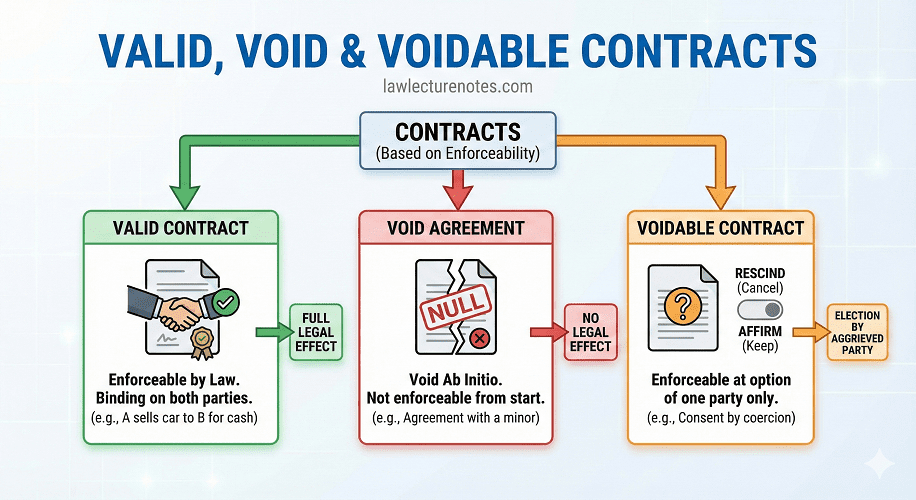
Valid, Void & Voidable Contracts

Spread the love

Spread the love      Contracts are classified into different categories based on their validity or enforceability. The Indian Contract Act, 1872, clearly defines which agreements are good in law and which are worthless paper. 1. Valid Contract (Section 2(h)) A valid contract is one that satisfies all the essential elements of Section 10 (Offer, Acceptance, Consideration, Capacity, … Read more


Spread the love

Lawful Consideration and Lawful Object (Section 23)

Spread the love

Spread the love      A contract might have all the technical essentials—offer, acceptance, and consideration—but if its purpose is illegal or immoral, the law will not touch it. Section 23 of the Indian Contract Act, 1872, acts as a filter to stop agreements that are harmful to society. 1. Section 23 Explained The section states that the … Read more


Spread the love

Doctrine of Privity of Contract

Spread the love

Spread the love      The Doctrine of Privity of Contract is a fundamental principle of English Common Law that is also applicable in India. It determines who has the right to enforce a contract in court. 1. Meaning and Principle The term “Privity” implies a connection or bond. The general rule is: “Only a party to the … Read more


Spread the love

Consideration – Section 2(d)

Spread the love

Spread the love      The doctrine of Consideration is one of the most fundamental principles of the Indian Contract Act. It is often described as the “price” of the contract. Without consideration, a promise is usually just a social obligation, not a legal one. 1. Meaning of Consideration Section 2(d) of the Indian Contract Act, 1872 defines … Read more


Spread the love

Communication of Offer, Acceptance & Revocation

Spread the love

Spread the love      In the Indian Contract Act, 1872, “Timing” is everything. Since the parties are not always sitting face-to-face (they might be in different cities sending letters), the law must define exactly when a contract is born and when it is too late to back out. 1. Communication of Offer (Section 4) The rule for … Read more


Spread the love

Acceptance – Section 2(b)

Spread the love

Spread the love      If an offer is the “question,” acceptance is the “answer.” Just as a lit matchstick causes no fire without gunpowder, an offer creates no legal rights until it is accepted. 1. Meaning of Acceptance Section 2(b) of the Indian Contract Act, 1872 defines acceptance as: “When the person to whom the proposal is … Read more


Spread the love

Proposal (Offer) – Section 2(a)

Spread the love

Spread the love      The starting point of any contract is a Proposal, commonly known as an Offer. Without a valid offer, there can be no acceptance, and consequently, no contract. 1. Meaning of Proposal The term “Proposal” is defined under Section 2(a) of the Indian Contract Act, 1872: “When one person signifies to another his willingness … Read more


Spread the love

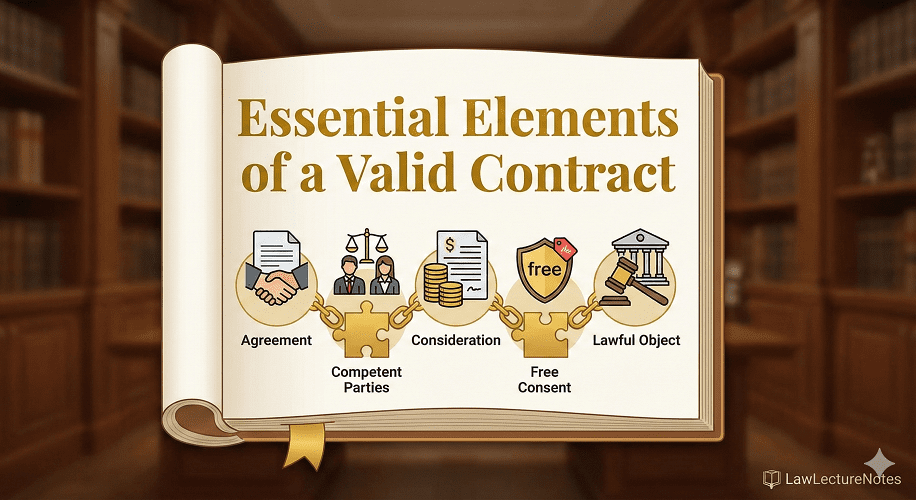
Essential Elements of a Valid Contract (Section 10)

Spread the love

Spread the love      For an agreement to become a contract, it must pass the “validity test” laid down in Section 10 of the Indian Contract Act, 1872. If any of these elements is missing, the contract may be void, voidable, or illegal. Section 10 states: “All agreements are contracts if they are made by the free … Read more


Spread the love