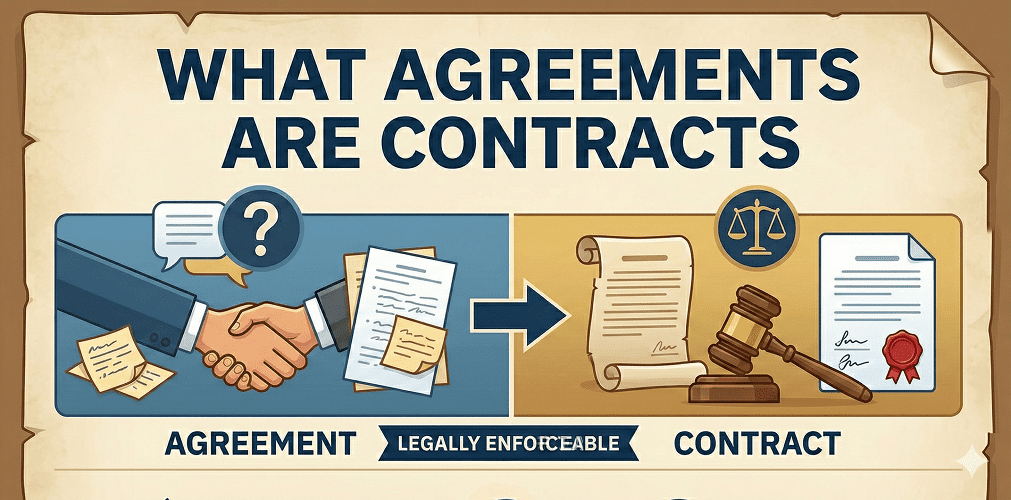
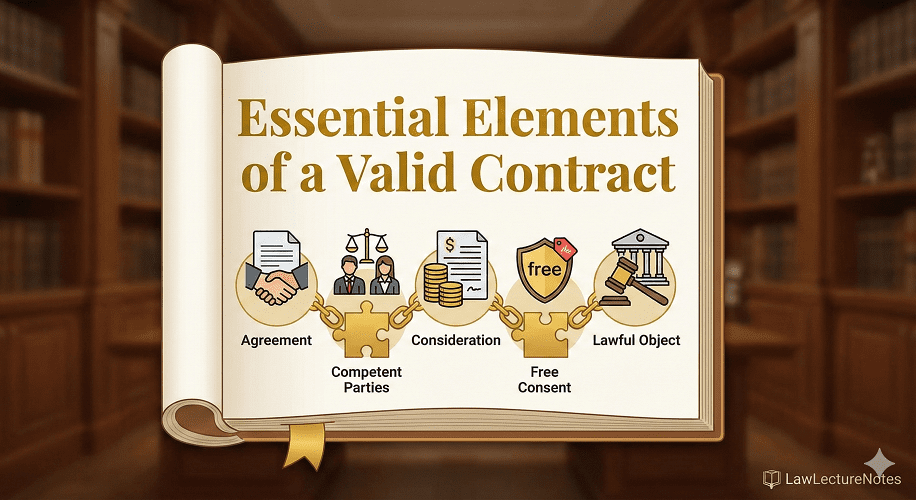
For an agreement to become a contract, it must pass the “validity test” laid down in Section 10 of the Indian Contract Act, 1872. If any of these elements is missing, the contract may be void, voidable, or illegal.
Section 10 states: “All agreements are contracts if they are made by the free consent of parties competent to contract, for a lawful consideration and with a lawful object, and are not hereby expressly declared to be void.”
Here is the detailed analysis of each element:
1. Offer and Acceptance
There must be a lawful offer by one party and a lawful acceptance of that offer by the other.
- Consensus ad idem: The acceptance must be absolute and unconditional. Both parties must agree upon the same thing in the same sense.
- Communication: An offer or acceptance in one’s own mind is not enough; it must be communicated to the other party.
- Case Law: Lalman Shukla v. Gauri Datt (Knowledge of the offer is essential for acceptance).
2. Lawful Consideration (Quid Pro Quo)
Consideration means “something in return” (Quid Pro Quo). A contract without consideration is generally void (Section 25).
- It need not be adequate: Even if you sell a house worth ₹1 Crore for ₹10 Lakhs, the consideration is valid if consent was free.
- It must be lawful: You cannot pay someone with drugs or stolen goods.
- Case Law: Chinnaya v. Ramayya (Consideration can move from a third party).
3. Competent Parties (Capacity to Contract)
According to Section 11, every person is competent to contract EXCEPT:
- Minors: A person below 18 years of age.
- Persons of Unsound Mind: Lunatics, idiots, or drunkards (while under the influence).
- Disqualified Persons: Insolvents, alien enemies, or convicts.
Landmark Case: Mohori Bibee v. Dharmodas Ghose (1903)
Held: A contract with a minor is void ab initio (void from the very beginning). The minor cannot be forced to refund any money taken.
4. Free Consent
Consent is not enough; it must be Free Consent. According to Section 14, consent is free when it is NOT caused by:
- Coercion (Sec 15): Committing or threatening to commit any act forbidden by the IPC (e.g., pointing a gun).
- Undue Influence (Sec 16): Using a position of power to dominate the will of the other (e.g., Doctor-Patient, Father-Son).
- Fraud (Sec 17): Intentionally deceiving someone.
- Misrepresentation (Sec 18): Innocent false statement.
- Mistake (Sec 20, 21, 22): Erroneous belief about facts.
5. Lawful Object
The “object” is the purpose of the contract. Even if the consideration is money (lawful), the purpose might be illegal.
Section 23 states that the object is unlawful if:
- It is forbidden by law.
- It defeats the provisions of any law.
- It is fraudulent.
- It implies injury to the person or property of another.
- The court regards it as immoral or opposed to public policy.
- Example: A pays B ₹10,000 to beat up C. The consideration (money) is valid, but the object (beating up C) is unlawful. This is a void agreement.
6. Not Expressly Declared Void
The Act specifically lists certain agreements that are void, regardless of whether the parties consented to them. These include:
- Agreement in restraint of marriage (Sec 26).
- Agreement in restraint of trade (Sec 27).
- Agreement in restraint of legal proceedings (Sec 28).
- Wagering Agreements (Betting/Gambling) (Sec 30).
Bonus Essential: Intention to Create Legal Relations
(While not in Section 10, this is a judicial essential).
Parties must intend legal consequences. Social agreements are not contracts.
- Landmark Case:Balfour v. Balfour (1919)
- Facts: A husband promised to pay his wife a monthly allowance but failed.
- Held: The wife could not sue because it was a domestic agreement with no intention to create a legal bond.
Summary Table for Quick Revision
| Element | Section | Key Question |
| Agreement | 2(e) | Is there an Offer + Acceptance? |
| Capacity | 11 | Are parties adults and sane? |
| Free Consent | 14 | Was there pressure or fraud? |
| Consideration | 2(d) | Is something being given in return? |
| Lawful Object | 23 | Is the purpose legal? |
Short H2 Heading
Lorem ipsum dolor sit amet, consectetur adipiscing elit.
-
 January 22, 2026
The Blueprint of a Binding Deal: Overview of Essential Elements of a Valid Contract
Spread the love In the world of commerce, thousands of promises are made every day. But when does a casual promise transform into a legally bindingRead more -
January 24, 2026
What Agreements Are Contracts? Decodifying Section 10
Spread the love In our daily lives, we make countless agreements. We agree to meet friends for coffee, agree to attend a family wedding, or agreeRead more -
January 24, 2026
Conclusion: The Importance of Chapter 1 in Contract Law
Spread the love We have now journeyed through the basics of the Indian Contract Act, 1872—from the first spark of an Offer to the binding sealRead more