In the world of commerce, thousands of promises are made every day. But when does a casual promise transform into a legally binding obligation? The answer lies in the Indian Contract Act, 1872.
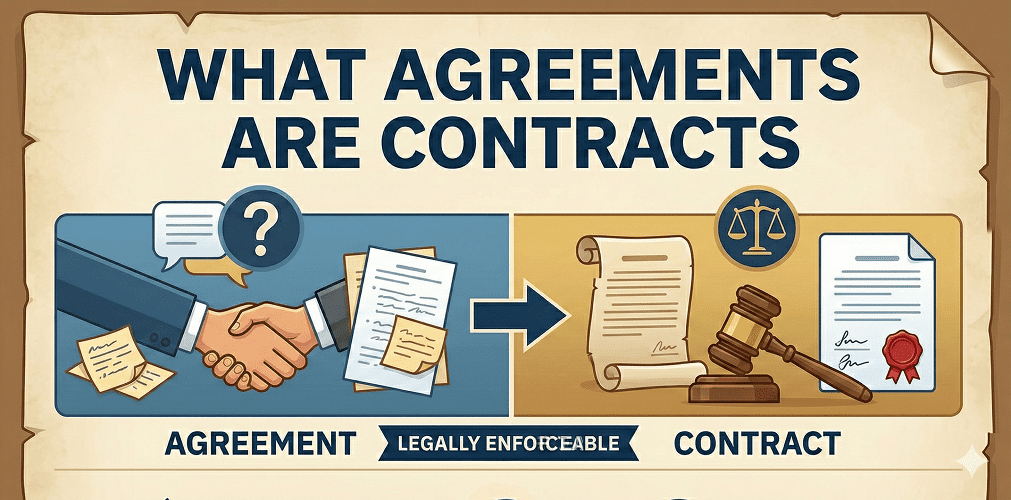
According to Section 2(h) of the Act, a contract is “An agreement enforceable by law.”2
To move from a mere “agreement” to an “enforceable contract,” the agreement must pass a strict validity test. This test is laid down in Section 10, which acts as the gatekeeper of contract law. It states that all agreements are contracts if they fulfill certain essential conditions.3
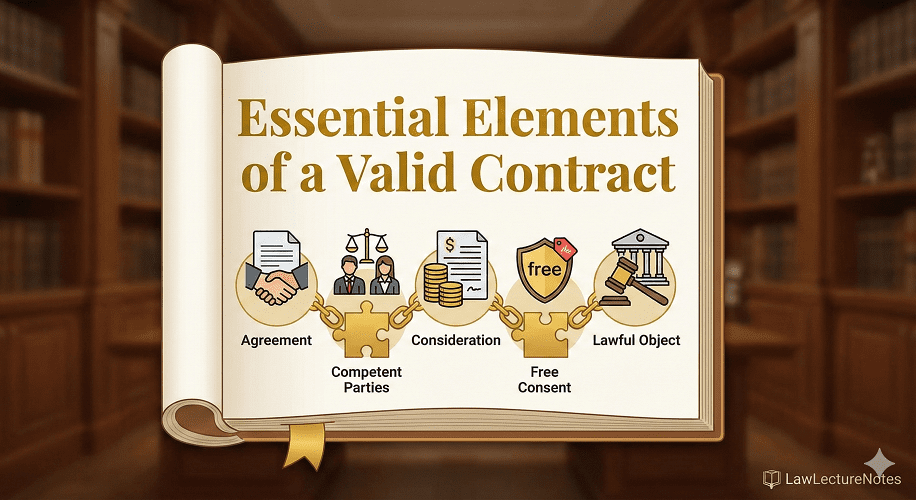
Here is an overview of the five crucial elements required for a valid contract, based on Section 10.
1. Free Consent (It Must Be Voluntary)
Sections 13-22
A contract must be a voluntary arrangement.4 The most basic requirement is consensus ad idem—meaning both parties must agree to the same thing in the same sense.
However, mere consent is not enough; it must be Free Consent. Consent is considered “free” only when it is not caused by pressure, deception, or error.5 If a person is forced or tricked into signing a contract, the law will not uphold it.6
Consent is NOT free if it is caused by:
- Coercion (Sec 15): Committing or threatening to commit any act forbidden by the Indian Penal Code (e.g., pointing a gun at someone to make them sign).7
- Undue Influence (Sec 16): Using a position of power or authority to dominate the will of another to gain an unfair advantage (e.g., a doctor pressuring a patient, or a guru pressuring a disciple).
- Fraud (Sec 17): Intentional deception to cheat the other party.8
- Misrepresentation (Sec 18): Innocent false statements made without the intent to deceive.
- Mistake (Sec 20-22): Where both parties are under a factual error regarding the subject matter.
Impact: If consent is caused by coercion, undue influence, fraud, or misrepresentation, the contract is usually Voidable (the victim can choose to cancel it). If caused by a mutual mistake of fact, the agreement is Void.
2. Competent Parties (Capacity to Contract)
Section 11
Not everyone is legally allowed to enter into a contract. The law protects certain vulnerable groups from binding themselves to legal obligations they may not fully understand.9
According to Section 11, a person is competent to contract ONLY IF they fulfill all three conditions:
- Age of Majority: They must be at least 18 years old. An agreement with a minor is void ab initio (dead from the very beginning).10
- Sound Mind: They must be capable of understanding the contract and forming a rational judgment about its effects on their interest. (Lunatics, idiots, or persons heavily intoxicated are temporarily or permanently incompetent).
- Not Disqualified by Law: They must not be barred by any other law (e.g., declared insolvent/bankrupt, or an “alien enemy” during a war).
3. Lawful Consideration (Quid Pro Quo)
Section 2(d) & 23
Contract law operates on the principle of reciprocity.11 A promise made for nothing in return is generally just a social obligation, not a legal one.
Consideration means “something in return” (quid pro quo). It is the price paid for the promise of the other party.
- It can be an act (doing something), an abstinence (not doing something), or a promise.
- It can be in the past, present, or future.
- Crucially, it must be lawful. You cannot pay someone with stolen goods or illegal drugs.
Example: A promises to sell his house to B for ₹50 Lakhs. Here, A’s promise to give the house is consideration for B, and B’s promise to pay money is consideration for A. Both are lawful.
4. Lawful Object (The Purpose Must Be Legal)
Section 23
Even if the consideration (e.g., money) is lawful, the object or the ultimate purpose of the agreement must also be lawful. The court will not enforce a contract designed to break the law.
Section 23 states that the object of an agreement is unlawful if:
- It is forbidden by law.
- It would defeat the provisions of any law.
- It is fraudulent.
- It involves injury to the person or property of another.
- The court regards it as immoral or opposed to public policy.
Example: A rents a house to B. The consideration (rent money) is legal. However, if B intends to use the house specifically for storing smuggled weapons, the object is unlawful, making the agreement void.
5. Not Expressly Declared Void
Sections 26-30
Finally, the Indian Contract Act explicitly mentions certain types of agreements that are void from the very beginning, regardless of whether the parties freely consented to them.12 The law deems these agreements harmful to society or individual liberty.
These include:
- Agreements in restraint of marriage (Sec 26).13
- Agreements in restraint of trade (stopping someone from doing business) (Sec 27).14
- Agreements in restraint of legal proceedings (stopping someone from going to court) (Sec 28).15
- Wagering Agreements (Betting/Gambling activities) (Sec 30).
A Note on the “Hidden” Essentials
While Section 10 lists the five elements above, judicial interpretation over the years has established two more essentials that are equally critical for a valid contract:
- Offer and Acceptance: There must be a valid offer by one party and a valid, unconditional acceptance by the other.
- Intention to Create Legal Relations: The parties must intend for their agreement to have legal consequences. Social or domestic agreements (like promises between husband and wife) usually lack this intention and are not contracts (Balfour v. Balfour).16
Conclusion:
Think of Section 10 as a checklist. If an agreement ticks all these boxes—free consent, competent parties, lawful consideration, lawful object, and not being expressly void—it graduates from being a mere agreement to a legally enforceable Contract.
Important articles
-
 January 22, 2026
The Blueprint of a Binding Deal: Overview of Essential Elements of a Valid Contract
Spread the love In the world of commerce, thousands of promises are made every day. But when does a casual promise transform into a legally bindingRead more -
January 24, 2026
What Agreements Are Contracts? Decodifying Section 10
Spread the love In our daily lives, we make countless agreements. We agree to meet friends for coffee, agree to attend a family wedding, or agreeRead more -
January 24, 2026
Conclusion: The Importance of Chapter 1 in Contract Law
Spread the love We have now journeyed through the basics of the Indian Contract Act, 1872—from the first spark of an Offer to the binding sealRead more