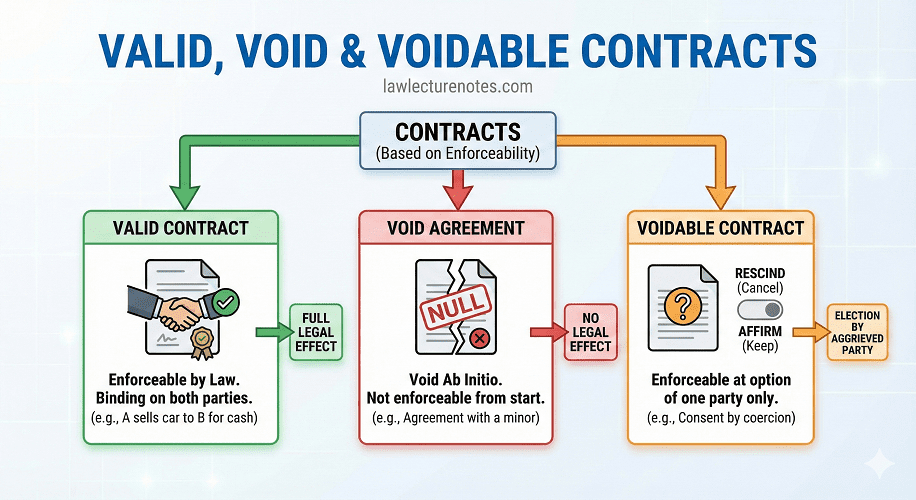
Contracts are classified into different categories based on their validity or enforceability. The Indian Contract Act, 1872, clearly defines which agreements are good in law and which are worthless paper.
1. Valid Contract (Section 2(h))
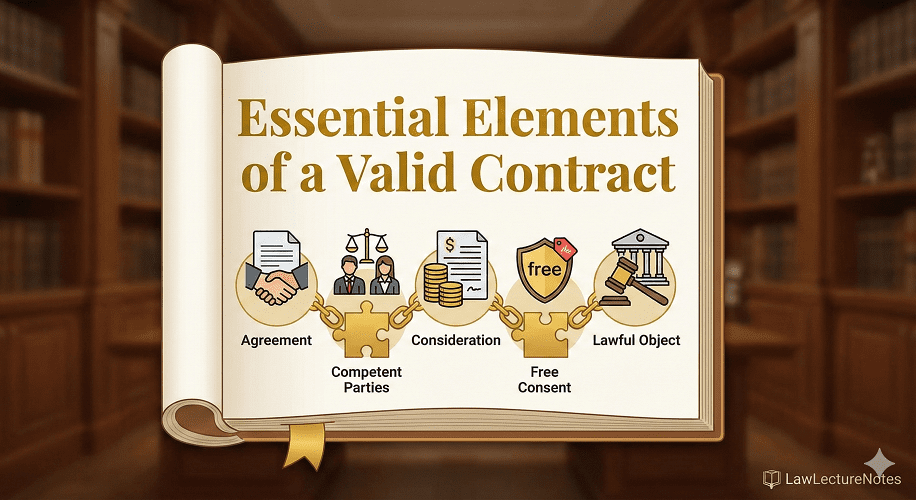
A valid contract is one that satisfies all the essential elements of Section 10 (Offer, Acceptance, Consideration, Capacity, Free Consent, etc.).
- Definition: “An agreement enforceable by law.”
- Status: It is fully binding. If one party breaks it, the other can go to court.
- Example: A sells his house to B for ₹50 Lakhs. Both are adults, consent is free, and the object is lawful. This is a valid contract.
2. Void Contract vs. Void Agreement (Crucial Distinction)
Students often confuse these two. In the eyes of the law, there is a big difference between something that was never a contract and something that became void.
A. Void Agreement (Section 2(g))
- Definition: “An agreement not enforceable by law is said to be void.”
- Status: It is Void Ab Initio (Void from the very beginning). It was dead the moment it was made.
- Reason: It lacks a core essential (e.g., agreement with a minor, illegal object).
- Example: A promises to pay B ₹10,000 if B murders C. This is a void agreement from the start.
B. Void Contract (Section 2(j))
- Definition: “A contract which ceases to be enforceable by law becomes void when it ceases to be enforceable.”
- Status: It was VALID when it was made, but something happened later that made it VOID.
- Reason: Subsequent impossibility or change in law.
- Example:
- Jan 1: A agrees to marry B. (Valid Contract).
- Jan 10: Before the wedding, A dies or goes mad.
- Result: The contract becomes a Void Contract on Jan 10 due to impossibility.
3. Voidable Contract (Section 2(i))
A voidable contract is a “sick” contract—it can be cured or killed.
- Definition: “An agreement which is enforceable by law at the option of one or more of the parties thereto, but not at the option of the other or others, is a voidable contract.”
- When does this happen? Usually when Consent is NOT Free (Coercion, Undue Influence, Fraud, Misrepresentation).
- Key Feature: The “Aggrieved Party” (the victim) has two choices:
- Rescind (Cancel) it: The contract ends, and they get their money/property back.
- Accept it: The contract remains valid and binding.
- Example: A points a gun at B and asks him to sell his car for ₹500. B signs the papers.
- This contract is Voidable at the option of B.
- B can go to court and say, “Cancel this, I was forced.”
- A (the coercive party) has no right to cancel it.
4. Difference Between Void and Voidable Contract
This is a favorite question for examiners.
| Basis | Void Contract | Voidable Contract |
| Definition | Ceases to be enforceable by law. | Enforceable at the option of one party only. |
| Validity | It is null. No legal effect. | It is valid until cancelled by the aggrieved party. |
| Cause | Due to impossibility or change in law. | Due to lack of free consent (Coercion, Fraud, etc.). |
| Rights | No party has any rights. | Aggrieved party has a right to rescind (cancel). |
| Performance | Cannot be performed. | Must be performed if the aggrieved party does not cancel it. |
5. Simple Examples for Understanding
Scenario 1 (Void Agreement – Void Ab Initio):
- Amit (aged 10) borrows ₹5,000 from Raj.
- Result: Void Agreement. Raj cannot sue Amit because a minor is not competent to contract (Mohori Bibee case).
Scenario 2 (Void Contract – Valid then Void):
- A agrees to sell 100 kgs of plastic bags to B. Before delivery, the Government bans plastic bags.
- Result: The contract was valid when made, but became void due to the new law.
Scenario 3 (Voidable Contract – Valid until Cancelled):
- X sells a fake gold ring to Y, claiming it is real diamond (Fraud).
- Result: The contract is Voidable at the option of Y.
- If Y wants to keep the ring, the contract remains valid.
- If Y wants to return it and get his money back, the contract becomes void.
Important articles
-
 January 22, 2026
The Blueprint of a Binding Deal: Overview of Essential Elements of a Valid Contract
Spread the love In the world of commerce, thousands of promises are made every day. But when does a casual promise transform into a legally bindingRead more -
January 24, 2026
What Agreements Are Contracts? Decodifying Section 10
Spread the love In our daily lives, we make countless agreements. We agree to meet friends for coffee, agree to attend a family wedding, or agreeRead more -
January 24, 2026
Conclusion: The Importance of Chapter 1 in Contract Law
Spread the love We have now journeyed through the basics of the Indian Contract Act, 1872—from the first spark of an Offer to the binding sealRead more