In our daily lives, we make countless agreements. We agree to meet friends for coffee, agree to attend a family wedding, or agree to buy milk from the shop. While all of these are “agreements,” only the last one is likely a “contract.”
Why does the law enforce the promise to pay for milk but not the promise to meet for coffee?
The answer lies in Section 10 of the Indian Contract Act, 1872. It acts as the sieve that filters casual social promises from legally binding business engagements.
1. The Golden Rule: The Relationship
Before diving into Section 10, we must understand the fundamental relationship between an agreement and a contract, summarized by the famous legal maxim:
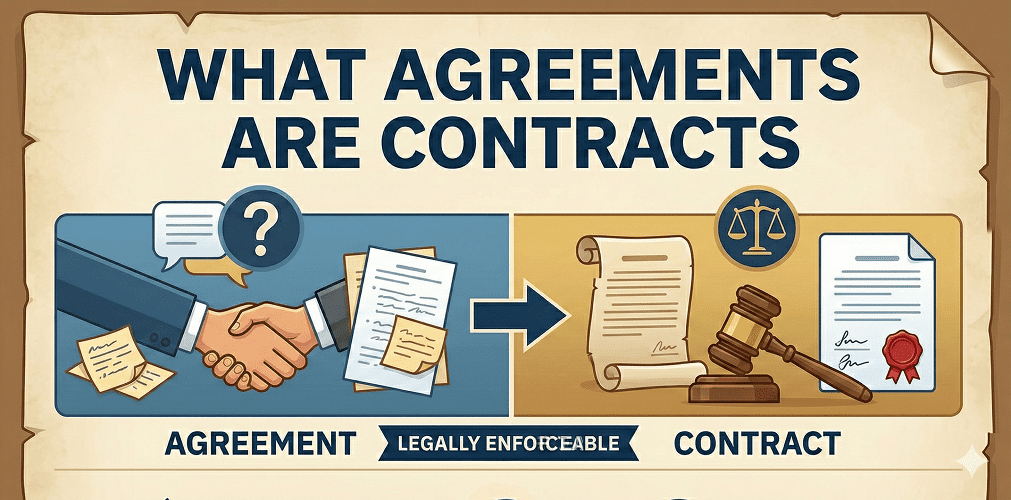
“All contracts are agreements, but all agreements are not contracts.”
- Agreement (Section 2(e)): Every promise and every set of promises, forming the consideration for each other. (Formula: Offer + Acceptance).
- Contract (Section 2(h)): An agreement enforceable by law.
Therefore, an agreement is a wider term. A contract is a narrower term—it is a specific type of agreement that has passed the “test of enforceability.”
2. Section 10 Explained: The Test of Validity
If you have an agreement and want to know if it’s a contract, you must apply the test laid down in Section 10.
The Text of Section 10
“All agreements are contracts if they are made by the free consent of parties competent to contract, for a lawful consideration and with a lawful object, and are not hereby expressly declared to be void.”
Meaning and Scope
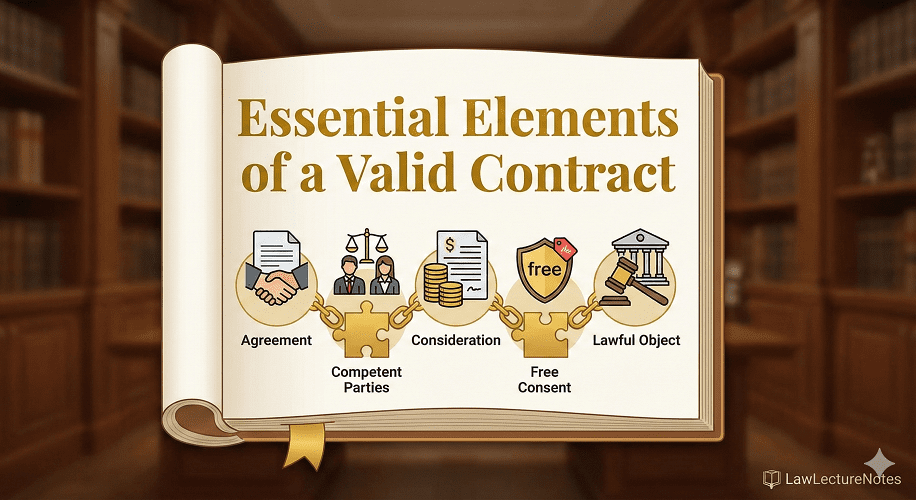
Section 10 defines the scope of enforceability. It lists the essential ingredients that must be present in an agreement for the law to recognize it as binding.
If an agreement lacks even one of these ingredients, it fails the test of Section 10 and remains just a mere agreement (void or voidable), not a valid contract.
3. Conditions for Enforceability (The Essentials)
While Section 10 specifically lists five conditions, a valid contract actually requires several more elements derived from other sections and judicial interpretation.
Here is the complete checklist for a valid contract:
A. The Essentials Mentioned in Section 10
1. Free Consent (Section 14)
The parties must agree to the same thing in the same sense (consensus ad idem), and this consent must not be caused by pressure or deception.
- Consent is NOT free if caused by: Coercion, Undue Influence, Fraud, Misrepresentation, or Mistake.
2. Competency of Parties (Capacity) (Section 11)
The people making the contract must be legally capable of doing so.
- They must be: Major (18+ years), of Sound Mind, and not disqualified by any other law (e.g., insolvent).
3. Lawful Consideration (Section 2(d) & 23)
There must be something in return (quid pro quo). A gratuitous promise (a gift) is generally not enforceable. Furthermore, this consideration must be lawful.
4. Lawful Object (Section 23)
The purpose of the agreement must not be illegal, immoral, fraudulent, or opposed to public policy.
- Example: An agreement to hire a hitman has a lawful consideration (money) but an unlawful object (murder). It is void.
5. Not Expressly Declared Void (Sections 26-30)
The Act specifically mentions certain agreements that are void from the start, regardless of consent.
- Examples: Agreements in restraint of marriage, restraint of trade, or wagering agreements (betting).
B. Other Essential Elements (Implied)
Besides the elements explicitly in Section 10, the following are also necessary:
6. Offer and Acceptance (Agreement)
There must be a lawful offer by one party and a lawful acceptance by the other.
7. Intention to Create Legal Relations
This is the most critical differentiator. The parties must intend for their promise to have legal consequences.
- Social/Domestic agreements are presumed not to have this intention (Balfour v. Balfour).
- Commercial agreements are presumed to have this intention.
8. Certainty of Meaning (Section 29)
The terms of the agreement must be clear and definite.
- Example: “I agree to sell you some oil” is void for uncertainty. “I agree to sell you 100 liters of Coconut Oil” is valid.
9. Possibility of Performance (Section 56)
An agreement to do an impossible act is void.
- Example: An agreement to discover treasure by magic is void.
4. Why All Agreements Are Not Contracts
The primary reason all agreements are not contracts is the absence of the Intention to Create Legal Relations.
Human beings make countless promises based on love, friendship, and social obligation. The law does not want to interfere in these private spheres.
Comparison Table
| Feature | Social/Domestic Agreement | Valid Contract |
| Example | “I will come to your birthday party.” | “I will sell you my car for ₹5 Lakhs.” |
| Nature | Based on trust and social norms. | Based on commercial necessity. |
| Intention | Parties do not intend legal consequences if broken. | Parties intend legal consequences if broken. |
| Section 10 Test | Usually fails (lacks intention or consideration). | Passes all tests of Section 10. |
| Remedy | None. You cannot sue your friend for missing the party. | You can sue for damages or specific performance. |
Conclusion:
Section 10 is the gateway between the social world of promises and the legal world of contracts. Only those agreements that carry the baggage of legal intention and satisfy the statutory requirements of Section 10 are allowed to pass through.
Important articles
-
 January 22, 2026
The Blueprint of a Binding Deal: Overview of Essential Elements of a Valid Contract
Spread the love In the world of commerce, thousands of promises are made every day. But when does a casual promise transform into a legally bindingRead more -
January 24, 2026
What Agreements Are Contracts? Decodifying Section 10
Spread the love In our daily lives, we make countless agreements. We agree to meet friends for coffee, agree to attend a family wedding, or agreeRead more -
January 24, 2026
Conclusion: The Importance of Chapter 1 in Contract Law
Spread the love We have now journeyed through the basics of the Indian Contract Act, 1872—from the first spark of an Offer to the binding sealRead more